
Your Passport to Stress-Free Living!
Ah, the terrific 30s! You’re straddling the line between youthful exploration and growing responsibilities. It’s a thrilling yet demanding time – especially for women. Managing a career, possibly a family, and a self-care routine could make you feel like a circus juggler.
So, where do hobbies fit in this jigsaw puzzle of life?
Hobbies for women in their 30s? you might ask, an eyebrow raised, skepticism looming in your eyes, a smirk threatening to spill over your lips. We get it. It sounds as ambitious as fitting an elephant in a phone booth, right?
But stick with us because this isn’t just about filling your calendar with yet another task. No, siree! It’s about carving out a sliver of joy, a chunk of peace, and a hefty slice of self-fulfillment in your busy schedule.
So, ladies, fasten your seatbelts because we’re about to embark on a hobby-hunting journey that doesn’t entertain you but uplifts you, empowers you, and leaves you with a grin that would make the Cheshire Cat proud.
And who knows, you might just find a piece of your heart you didn’t realize was missing. Curious? Excited?
Maybe a tad bit skeptical? Fantastic!
Let’s get started!
Here's What You Will Find

Key Takeaways
The Power of Hobbies: Hobbies are not just pastimes but potent tools for stress relief and improving mental well-being. They can also serve as creative outlets that provide a sense of accomplishment and joy.
The Balancing Act: Despite the demands of work, family, and personal responsibilities, it’s crucial to carve out some “me-time” for hobbies. They help to restore balance, providing an enjoyable break from everyday tasks.
Hobbies are Personal: Your hobbies should be an expression of you! Choose what resonates with your interests and lifestyle, whether it’s physical activities, creative arts, intellectual pursuits, or community-centered hobbies.
The Beauty of Diversity: Hobbies are as diverse as we are, influenced by our cultures, lifestyles, age, and abilities. They manifest our identity beautifully and should be embraced and celebrated.
Why is Finding a Hobby Important for Women in Their 30s?
Your 30s are a marvelous, magical mess. It’s the era where life feels like a panoramic landscape of opportunities. You’re at the helm of your career, your personal life may be buzzing with activity, and you’re grappling with an ever-evolving sense of self. It’s as if you’re on a rollercoaster that’s simultaneously exhilarating and exhausting.
But amidst the pandemonium, a hobby can act as your personal oasis—a tranquil corner where you can breathe, decompress, and simply be.
So, why exactly is finding a hobby crucial for women in their 30s? Let’s lift the lid off this pandora’s box.
First off, hobbies for women in their 30s are the ultimate stress busters. According to an article published in the Journal of Occupational and Organizational Psychology, engaging in hobbies can significantly lower stress and boost mood. It’s your ticket out of Anxiety Avenue and onto Tranquility Terrace.
Next, hobbies help flex the creativity muscles. By stepping away from your everyday routine and embracing a creative pursuit, you are nudging your brain to think in new ways, sparking ideas that you wouldn’t usually entertain. It’s like giving your grey cells a fun little workout.
Then there’s the undeniable confidence boost. Whether you’re nailing a new yoga pose, getting the hang of watercolor painting, or learning to play the ukulele, hobbies let you experience small victories, enhancing your self-esteem. After all, who doesn’t want to feel like Superwoman every now and then?
Moreover, hobbies for women in their 30s offer a platform for social connection. Joining a book club, a gardening group, or a hiking community can open doors to meaningful relationships. You’ll share laughter, encouragement, and camaraderie with fellow hobbyists. You might just find your tribe!
Finally, hobbies allow you to live in the moment. They offer an escape from the nagging need to plan, prepare, and preempt that comes with adulthood. When you’re engrossed in a hobby, it’s all about the here and now.
So, ladies, finding a hobby isn’t just about killing time or staying busy. It’s about nurturing your soul, tickling your curiosity, and lighting up your life in ways you can’t imagine.
But wait, are you already wondering how to squeeze a hobby into your jam-packed schedule?
Let’s tackle that next, shall we?
Understanding the Challenges of Being a Woman in Your 30s
Juggling Work and Domestic Responsibilities: How Real Is the Struggle?
We all remember that game from childhood, right?
The one where we try to keep multiple balls in the air simultaneously? As adults, the balls got replaced with responsibilities, but the juggling act never ended, especially for women in their 30s.
It’s like spinning plates on sticks between career progression, family responsibilities, maintaining relationships, and self-care. And let’s not even get started on societal expectations, the unwritten rules that prescribe what a woman’s life should look like. Phew!
According to a study published by the American Sociological Review, women spend an average of 22 hours per week on domestic responsibilities, even while working full-time.
So, the struggle is as real as it gets. As the work and home demands escalate, stress tends to creep in, and personal time slips out of your grasp like sand trickling through your fingers.
Can a Hobby Help Ease the Stress?
But here’s where hobbies step in, wearing a shiny, red cape like your personal superheroes. They’re not just a fun distraction. They are, in fact, a potent tool to help you manage stress and maintain a healthy work-life balance.
Hobbies for women in their 30s give you a unique opportunity to take a break from the constant juggling act and do something that’s solely for you. You might think, “But isn’t that just adding another ball to juggle?”
The beautiful thing about hobbies is that they’re not about ‘should’ or ‘must.’ They’re about ‘want.’ They’re about choosing to spend time doing something that brings you joy.
When you engage in a hobby, you give your mind a much-needed vacation from the whirlwind of responsibilities. It’s like pressing the ‘pause’ button on your stress. According to a study published in the Annals of Behavioral Medicine, leisure activities, including hobbies, can lower heart rates and cortisol levels (the infamous stress hormone).
So, in a nutshell, hobbies for women in their 30s aren’t an additional chore. They’re your lifeline, stress antidote, and personal slice of sunshine in the storm of responsibilities.
But how do you find the time for hobbies amidst your overflowing schedule?
How to Find Time for Hobbies Amidst Busy Schedules?
Quick Tips to Carve Out “Me-Time”
“Time? For a hobby?”
I can hear you chortle, picturing your planner stuffed with appointments, meetings, and tasks that spill over the margins. But here’s the real kicker – finding time for hobbies isn’t about discovering a hidden 25th hour in your day. It’s about mindful time management, prioritizing, and, yes, a little bit of wizardry (okay, maybe not that last one!).
Here are a few quick tips to help you carve out that golden “me-time”:
Start with Baby Steps
Nobody asks you to train for a marathon or master Beethoven’s Symphony overnight. Begin with just 15-30 minutes a day. You’ll be surprised how these snippets of time add up and contribute to your overall well-being.
Make it a Date
Schedule your hobby time just like you would an important meeting. Yes, put it on your calendar. Seeing it there in ink (or pixels) makes you more likely to commit to it. And why not? You deserve a meeting with yourself!
Multitask with Caution
Listen to an audiobook while doing chores or practice mindfulness while walking. But remember, the essence of a hobby is to enjoy the moment fully, so use multitasking wisely.
Utilize Your Weekends
Weekends are the treasure troves of time. Dedicate a couple of hours each weekend to your hobby. It’s a great way to de-stress and rejuvenate for the upcoming week.
Less Scrolling, More Doing
Let’s face it, we all are guilty of disappearing down the social media rabbit hole. Swap some of this screen time for your hobby. You’ll be amazed at how much time you can salvage!
Delegate and Share Responsibilities
If household chores are eating up your time, consider dividing the responsibilities among family members or outsourcing if feasible. It’s not about shirking duties but creating a balance.
Remember, the goal here isn’t to fill every minute of your day with tasks and activities. It’s about setting aside some sacred time to engage in something you love that lights you up from the inside and gives you a spring in your step.
Because that’s what hobbies are all about, right?
Why is it Essential to Choose a Hobby Based on Personal Interests and Lifestyle?
Factors to Consider When Picking a Hobby
Hobbies are like a pair of shoes; they need to fit just right to be comfortable. You wouldn’t don a pair of sky-high heels for a hiking trip or sports flip-flops to a formal gala.
Similarly, picking a hobby based on your interests and lifestyle is crucial to enjoy and sustain it truly.
Here’s why:
When you choose a hobby that aligns with your interests, you are likelier to engage in it consistently. It becomes a joy rather than a chore. Plus, it provides a genuine opportunity to grow and evolve, making you feel motivated and accomplished.
On the other hand, your lifestyle plays a significant role in determining how practical your hobby is. For example, if you’re always on the move due to work or family commitments, a hobby like painting that requires a set space and materials might not be the best fit. In contrast, something portable like reading, knitting, or digital art could be more suitable.
So, how do you find the ‘Cinderella fit’ regarding hobbies?
Here are some factors to consider:
1. Personal Preferences:
What are your likes and dislikes? Do you enjoy solitude or thrive in social settings? Do you love physical activities or prefer intellectual stimulation? Answering these questions can help narrow down the field of potential hobbies.
2. Time Commitment:
How much time can you realistically dedicate to your hobby each week? Ensure that your chosen hobby fits within these time constraints.
3. Accessibility and Convenience:
Does your hobby require specific materials, a dedicated space, or a group of people? Consider the practicality based on your lifestyle.
4. Scope for Growth:
Look for a hobby that offers room for development and progression. The sense of achievement you gain as you improve can be incredibly satisfying.
5. Cost:
Unfortunately, some hobbies come with a price tag. Make sure your new interest aligns with your budget.
Remember, your hobby should be your sanctuary, not a source of stress. It should feel as comfy as your favorite pajamas and as exciting as a surprise gift.
And speaking of exciting, in the next section, we’ll unwrap some fantastic hobby choices for women in their 30s. Ready to rumble?
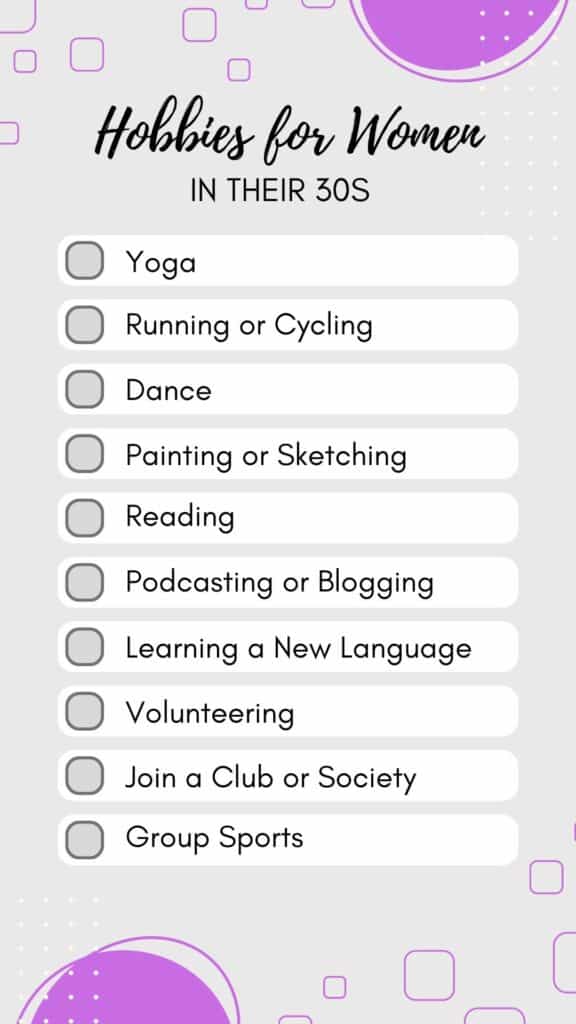
Exploring 10 Hobbies for Women in Their 30s
What Are Some Great Choices?
Navigating through your 30s and losing yourself amidst the myriad responsibilities is easy. But fret not; we have a list of fantastic hobbies that can cater to various interests. Let’s jump into this magical carousel of hobbies, shall we?
Keep Fit and Fab: Sports and Exercise Hobbies
Let’s kickstart things (quite literally) with a set of hobbies that can get your heart pumping and your adrenaline racing.
Yoga
This ancient practice goes beyond physical fitness. It’s a holistic approach to well-being that combines postures, meditation, and breathing exercises. Yoga can be a serene sanctuary in your chaotic life, improving your flexibility, strength, and mental peace.
Getting Started: To start your yoga journey, consider joining a local yoga class or following an online yoga tutorial that suits your experience level. Remember to invest in a good yoga mat and comfortable clothing that allows you to move freely.
Running or Cycling
If you love the feel of the wind in your hair and the exhilaration of speed, running or cycling can be an amazing hobby. Plus, there’s the added benefit of exploring your neighborhood, local parks, or nature trails.
Getting Started: Kickstart your running or cycling hobby by setting achievable goals for yourself. You could use a fitness tracking app to monitor your progress. Don’t forget to invest in a good pair of running shoes or a quality bicycle for a safe and comfortable ride.
Dance
From Zumba to ballet, salsa to hip-hop, dance can be an excellent stress buster and an enjoyable way to stay fit. After all, who said exercise couldn’t be fun?
Getting Started: Starting a dance hobby can be as simple as signing up for a dance class in a genre you’re interested in. Alternatively, you could also use online dance workout videos to groove your way to fitness right at home. Make sure you have plenty of room to move around safely!
Creative Minds at Play: Artistic Hobbies
If you lean more towards the creative side, these artistic hobbies might flutter your heart.
Painting or Sketching
There’s something incredibly calming about putting a brush or pencil to paper. Whether it’s capturing landscapes, abstract ideas, or whimsical doodles, painting or sketching can be an outlet for your emotions and creativity.
Getting Started: Begin your journey into the world of painting or sketching by choosing your preferred medium. Acquire basic art supplies like a sketch pad, pencils, erasers, paintbrushes, and paints. Numerous online tutorials and art classes can help you make the first stroke.
DIY Crafts
From home, décor to handmade jewelry, the realm of DIY crafts is vast and exciting. Not only do you get to create something unique, but it’s also a great way to add a personal touch to gifts for your loved ones.
Getting Started: To embark on your DIY craft adventure, choose a simple project to start with and gather the necessary materials. Online platforms like Pinterest and YouTube are treasure troves of DIY craft ideas and step-by-step tutorials.
Photography
With the amazing camera technology available today, anyone can dabble in photography. It’s about capturing moments, perspectives, and emotions. And the best part? Your canvas is as big as the world around you!
Getting Started: If you’re interested in photography, start by understanding the basics of your camera (even if it’s your smartphone). There are many online photography courses and tutorials that can guide you. Begin by practicing in your immediate surroundings and slowly venture out to capture the world through your unique lens.
Mind Matters: Intellectual Hobbies
If mental stimulation is what you’re after, these intellectual hobbies can tickle your fancy.
Reading
It’s a timeless hobby that can transport you to different worlds, cultures, and minds. Join a book club to add a social element to this traditionally solitary hobby.
Getting Started: To start with reading as a hobby, choose a genre or author that piques your interest. Your local library, bookstores, or online platforms can be great book sources. Consider joining a local or online book club to discuss and share thoughts about the books you read.
Podcasting or Blogging
Share your thoughts, ideas, or experiences with the world. It’s a great way to connect with like-minded individuals and also improve your communication skills.
Getting Started: If you want to start podcasting or blogging, select a topic you are passionate about. Choose a platform that suits your needs, and start creating content. Consistency is key; engaging with your audience can help build a community.
Learning a New Language
Not only does it stimulate your brain, but it also opens doors to new cultures. With numerous online resources and apps, this hobby is more accessible than ever.
Getting Started: To start learning a new language, choose a language that interests you, and explore online language learning platforms or apps like Duolingo or Rosetta Stone. Making a regular learning schedule can help you progress steadily.
Social Butterflies: Community-Centered Hobbies
If you’re a social butterfly, these community-centered hobbies might make your spirit soar.
Volunteering
It’s a hobby that feeds the soul. Choose a cause you’re passionate about and give back to the community. The joy of making a difference is incomparable.
Getting Started: To start volunteering, research local organizations that align with your interests and inquire about volunteer opportunities. Remember, even small actions can make a big difference, so don’t hesitate to start small.
Join a Club or Society
Whether gardening, cooking, hiking, or film, joining a club can be a fun way to pursue a hobby and meet new people.
Getting Started: Identify your interests and search for local clubs or societies that cater to them. Most clubs welcome new members and provide an enriching platform to learn and share knowledge.
Group Sports
Join a local sports team, be it soccer, basketball, or even frisbee! It’s a great way to combine exercise, team spirit, and socialization.
Getting Started: If you’re interested in group sports, check out local community centers, recreational leagues, or sports clubs. Join a team that suits your skill level and enjoy the camaraderie of team spirit and the thrill of competition.
Remember, these are just suggestions. The right hobby for you might be a mix of these or something entirely different. The key is to choose something that sparks joy and excitement in you. And who knows, as you explore, you might stumble upon a hidden talent or passion.
Wouldn’t that be a delightful cherry on top of the hobby cake?
Let’s sneak a peek at some inspiring stories of women who’ve found balance through hobbies.
Get ready for some serious hobby envy!
The Power of Hobbies: Inspirational Stories
Meet The Women Who’ve Found Balance Through Hobbies
If you’re feeling a smidge skeptical about the impact of hobbies, buckle up! It’s time to embark on a journey through the life-changing stories of women who’ve embraced hobbies to strike a beautiful balance in their 30s.
Sarah, the Yogini: An ambitious marketing professional, Sarah often engulfed herself in stress. A chance encounter with yoga changed her life. Despite her demanding schedule, she carved out time daily to practice yoga, often waking up before dawn. The result?
A calmer, more focused Sarah who now excels in her career and runs a popular Yoga YouTube channel. Talk about a stretchy success!
Rebecca, the DIY Queen: With a busy life juggling between her job and twin toddlers, Rebecca barely had time for herself. One day, she decided to give DIY crafts a go, specifically creating playful home décor. It started as a fun project to involve her kids and transformed into a therapeutic hobby.
Fast forward to today, Rebecca now owns a successful Etsy shop selling her creations. Who knew that craft glue could hold together sanity, fun, and a side business, all at once?
Jill, the Bibliophile: Jill always loved reading but couldn’t find the time as a busy lawyer. One day, she stumbled upon an old favorite book of hers and decided to commit 30 minutes each day to reading. It wasn’t easy initially, but Jill stuck to her ‘bookish’ commitment.
Jill has rekindled her love for literature and started a book club that serves as a space for intellectual exchange and camaraderie among women in her city. Jill’s story is a beautiful reminder that sometimes, life’s greatest adventures can be found within the pages of a book.
Emily, the Green Thumb: Emily always admired her grandmother’s lush garden but felt she lacked the time and skill for gardening. However, when Emily moved to a house with a small backyard, she decided to give gardening a go. It was a struggle initially – more plants met their untimely demise than Emily cares to admit.
But with time, patience, and many YouTube tutorials, Emily’s garden started to bloom. Gardening now serves as her sanctuary from the hustle and bustle of life, a quiet place where she can connect with nature and herself. Plus, her salads are now the talk of the town, courtesy of her homegrown veggies!
These stories underline that hobbies aren’t just a way to kill time; they’re powerful tools for personal growth, stress management, and even social connection.
So why wait? Embrace a hobby today and watch as it paints vibrant strokes on the canvas of your life.
Research Insights: What Does Science Say About Hobbies and Well-being?
Amidst the chaos of life, hobbies can seem like frivolous pastimes. But science has something different to say. Let’s explore how hobbies can be secret superheroes for our well-being.
Mental Health and Hobbies: What’s the Connection?
We’ve all experienced that sense of peace while engrossed in a favorite pastime, but did you know there’s a scientific reason behind this?
According to a study published in the Journal of Occupational and Organizational Psychology, engaging in hobbies can significantly reduce stress and improve mood (Newman, D. B., Tay, L., & Diener, E., 2014). Hobbies provide a break from routine, serving as a rejuvenating escape from daily stressors.
Further, a study from the Journal of Happiness Studies found that individuals with hobbies have higher levels of positive affect and lower levels of depression and stress (Kuykendall, L., Tay, L., & Ng, V., 2015). This can be attributed to the sense of accomplishment and self-efficacy in pursuing a hobby.
Physical Benefits of Having a Hobby: Is There Any Truth to It?
As strange as it may sound, the answer is a resounding yes! Besides the obvious physical benefits of exercise-based hobbies like yoga or running, even non-physical hobbies can contribute to physical well-being.
How, you ask? The answer lies in the link between mental and physical health. Chronic stress and anxiety can lead to many physical health issues, including heart disease and weakened immune function. By serving as an effective stress reliever, hobbies can indirectly contribute to improved physical health.
Moreover, research in the Psychosomatic Medicine Journal found that leisure activities, including hobbies, are associated with lower blood pressure, total cortisol, waist circumference, and body mass index. They also lead to perceptions of better physical function (Pressman, S. D., Matthews, K. A., Cohen, S., et al., 2009).
Hobbies are more than just time-fillers; they’re wellness boosters.
So next time you pick up that paintbrush or lace up those running shoes, know that you’re doing a world of good for your mental and physical health.
Who knew self-care could be this fun!
Turning Challenges into Opportunities: Practical Tips to Embrace a New Hobby
Hobby 101: How to Start and Stick with It?
Picking up a new hobby can be exhilarating, but sticking to it? That can be trickier than folding a fitted sheet (and we all know how that ends).
But worry not!
Here are some practical tips that can transform you from a hobby dabbler to a hobby master.
Start Small
Rome wasn’t built in a day, and neither is a hobby. Instead of diving headfirst into the deep end, take baby steps. For instance, if you’re keen on running, start with short distances and gradually increase your stamina.
Schedule it
Make your hobby a non-negotiable part of your daily or weekly routine. Block out a specific time for your hobby as you would for any important meeting or appointment.
Celebrate Progress
Progress isn’t just about the final goal; it’s about the small wins along the way. Celebrated your first 1k run? Did you get a decent sketch after countless attempts? Celebrate these milestones, no matter how small they seem.
Find Your Tribe
Finding a community of people who share your hobby can be incredibly motivating. This could be an online forum, a local club, or even a friend who shares your interest.
Be Patient
Remember, it’s about the journey, not the destination. It’s okay to take your time to hone your skills. After all, even Picasso didn’t paint his masterpiece in a day.
Keep it Fun
The most crucial tip of all – keep it fun! If your hobby starts feeling like a chore, switch things up. Try a different approach or even a different hobby. The goal is to bring joy and relaxation, not added stress.
Armed with these tips, you’re all set to embark on your hobby adventure. Remember, the key to a successful hobby is perseverance and enjoyment.
So go forth and hobby on, my friend! You’ve got this.
Closing the Gap: Recognizing Diverse Experiences
How Hobbies Can Differ Across Cultures and Lifestyles
As we explore the world of hobbies, we must acknowledge that hobbies aren’t a one-size-fits-all affair. What makes our hearts race with excitement can be as unique as our fingerprints.
Our hobbies can be influenced by a kaleidoscope of factors, including our cultural backgrounds and lifestyles.
Cultural Richness
Our cultural heritage can indeed be a treasure trove of hobby ideas, especially for ethnic women. For instance, if you’re an ethnic woman with an Indian heritage, you could explore the graceful art of Indian classical dance.
Similarly, if you’re an ethnic woman of Japanese descent, you might find peace and tranquility in the ancient practice of Ikebana (Japanese flower arrangement). Embracing our cultural roots can be a meaningful form of self-expression and a way of keeping traditions alive.
Lifestyle Diversity
Our lifestyle and personal circumstances can significantly influence our hobby choices. A single mother might choose quick, at-home workouts as a hobby for convenience, while a digital nomad might opt for travel photography.
It’s all about finding a hobby that fits into your unique life puzzle.
Age and Ability
Hobbies aren’t bound by age or physical abilities. A woman in her 30s could find joy in gardening, while a woman in her 60s could take up salsa dancing. Similarly, hobbies can be adapted to cater to different abilities, ensuring everyone gets a fair shot at discovering their passion.
Our hobbies, much like our identities, can be multi-dimensional and ever-evolving. So, embrace your unique hobby journey, whether you’re an amateur baker, a budding novelist, or a late-night salsa dancer. It’s your passion, your rules.
Always remember – hobbies are like rainbows; they come in all shapes, sizes, and colors, each one beautiful and unique in its own right. So, let’s celebrate this diversity and embark on our own colorful hobby journeys!
Empowering Yourself Through Hobbies
With the world spinning around us in a constant state of rush, finding solace in hobbies for women in their 30s is not just self-care; it’s self-celebration. It’s about creating a little sanctuary of joy where you can feel seen, heard, and capable. It’s about silencing the external noise and tuning in to the sweet symphony of your heart, one hobby at a time.
Your hobbies aren’t just activities; they express your individuality. They’re a testament to your resilience, creativity, and your unwavering quest for balance amidst life’s ups and downs.
So, step out into the world, empowered by the knowledge that you have the power to create happiness right at your fingertips. Carry this power with you, let it guide you through the colorful maze of hobbies, and don’t forget to sprinkle the joy around.
We’ve walked together on this exciting journey exploring hobbies for women in their 30s. Now, it’s your turn to set sail. Share your experiences, highs, lows, and eureka moments. Encourage other women to navigate their way toward finding balance and joy through hobbies. Remember, your story could be the lighthouse guiding someone through a stormy sea.
If you’re still on the hunt for that perfect hobby, don’t worry! Feel free to check out our other articles on hobbies for women. They’re jam-packed with more exciting and diverse hobby alternatives that could inspire you to find your new favorite pastime.
If you found this post helpful, consider sharing it with your friends, family, colleagues – any woman who might be standing at the crossroads, looking for a sign. Let’s build a community where we lift each other up, one hobby at a time.
And remember, we’re here for you every step of the way. Don’t hesitate to reach out if you ever need a helping hand or just someone to cheer you on. Because at the end of the day, hobbies are about connection – with ourselves, each other, and the world around us.
Here’s to embarking on a hobby journey that’s as unique and wonderful as you are.
Happy hobbying!
More on Hobbies for Women
Hobbies for Women Over 60: The Mind-Blowing Activities That Will Transform Your Golden Years!

7 Hobbies That Make Money for Women: The Astonishing Guide to Earning Big From Home!
Outdoor Hobbies for Women: Step Outside and Ignite Your Passion Today!
Hobbies for Women Over 50: Reclaim Your Passion and Ignite Your Spirit!
Hobbies for Women in their 40s: Transform Your Free Time Into Pure Magic!
15 Hobbies for Women in Their 20s: Spark Joy and Master New Skills!
75 Hobbies for Women: Fuel Your Soul and Ignite Your Creativity!
Related Articles
Eat the Frog Technique: Transform Your To-Do List into a Done List!
9 Benefits of Time Management: How to Add More Hours to Your Day and Achieve Your Dreams!
101 Powerful Time Management Quotes to Transform Your Day!
Time Management for Women: Unlock the Life-Changing Power of Every Second!
Time Management Tips for Busy Women: Squeeze More Out of Your Day with These Eye-Opening Techniques!