

How the Eat the Frog Technique Gets the Worst Job Done First
Pick tomorrow’s hardest task tonight, then do it before anything easier gets a chance.
The Eat the Frog technique means doing the hardest thing on your list before you do anything easier. You pick it the night before, and you start it in the first stretch of the day you actually control.
That last part is where most versions of this advice fall apart. They assume the morning belongs to you, and for a lot of women the first two hours are already spoken for.
We’ll show you how to pick tomorrow’s frog tonight using four questions, and what to do when the frog turns out to be a person rather than a task.

Key takeaways
- Pick tomorrow’s frog tonight. Choosing while the day is already running is how it stops being the frog.
- The frog is usually the one involving a person, not the one that’s technically hardest.
- Start it in the first stretch of the day you genuinely control, even if that lands at two in the afternoon.
- Procrastination tracks impulsiveness and how unpleasant a task feels, not character.
What is the Eat the Frog technique?
Imagine starting your day with a sense of accomplishment, a feeling that the hardest part is already behind you. That’s the essence of the technique.
This concept, often linked to Mark Twain’s wisdom, suggests that if you start your day by accomplishing your most challenging task, your “frog,” you can go through the rest of the day with a sense of achievement and fewer burdens.
The Eat the Frog First technique is a time management method that encourages tackling the most challenging and important task of your day first, based on the idea that completing this significant task early creates momentum and sets a positive tone for the rest of the day.
In practical terms, the “frog” is one task you have no motivation to do on your to-do list.
It’s often the one that matters most and demands the most effort, discipline and energy. The idea behind eating this proverbial frog is not to consume an amphibian but to tackle your biggest, most daunting task first thing in the morning.
What makes it work is order, not effort. The hard thing gets your attention while you still have some, instead of whatever is left at four in the afternoon.
It’s a decision about order, made in advance, so dread doesn’t get to set your schedule for you.
The origin of the Eat the Frog technique
The phrase is usually attributed to Mark Twain, though nobody’s found it in anything he actually wrote.
The version that gets passed around goes, “If it’s your job to eat a frog, it’s best to do it first thing in the morning.”
“And if it’s your job to eat two frogs, it’s best to eat the biggest one first.”
Whether or not Twain said it, the idea’s older than he is. Doing the worst job first survives as advice because it removes the decision rather than the difficulty.
The modern interpretation and application of the approach in productivity and time management were popularized by Brian Tracy in his book “Eat That Frog!” Tracy’s work expanded on the concept, providing practical advice and strategies for prioritizing tasks and managing time effectively.
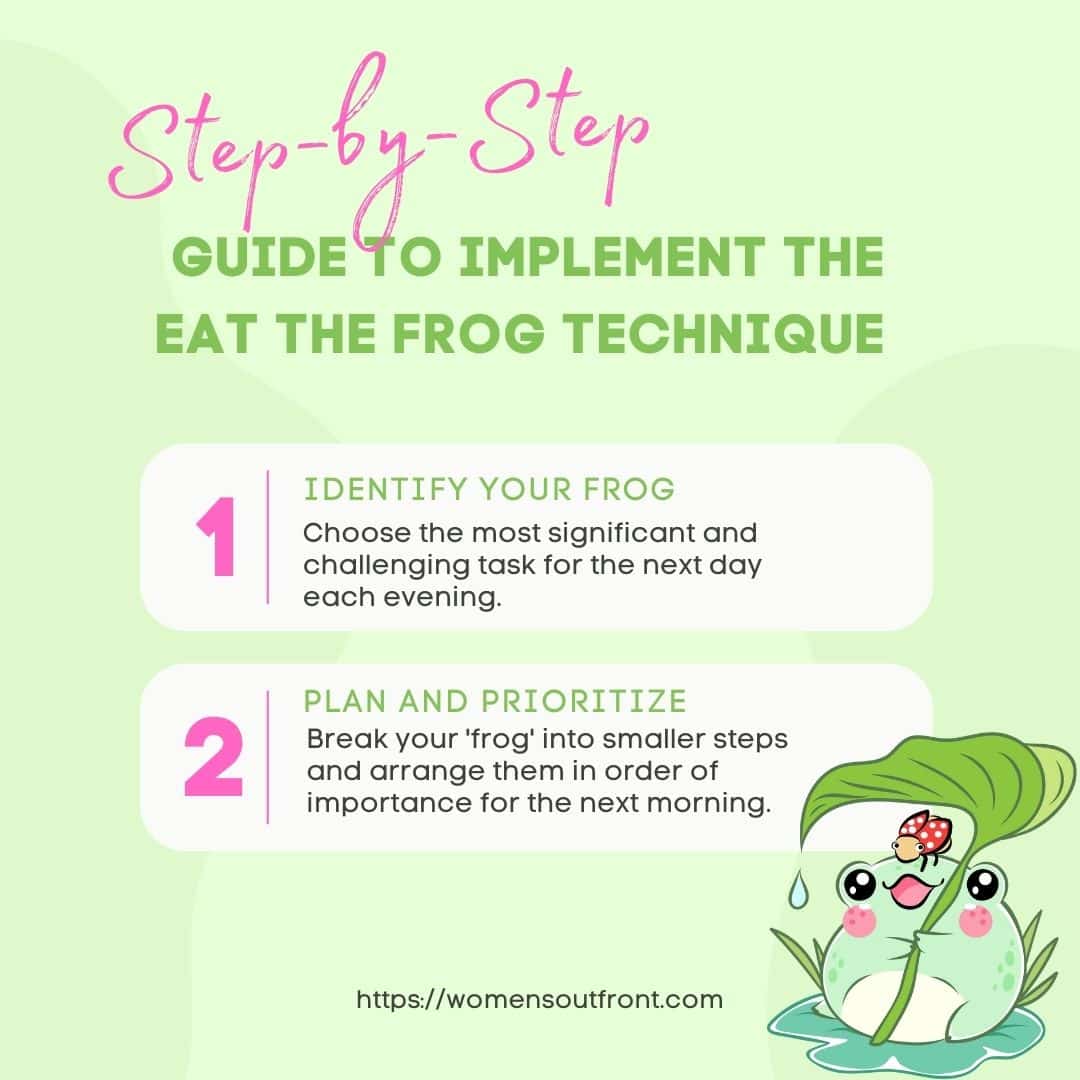
Step-by-step guide to implementing the Eat the Frog technique
Using the Eat the Frog technique takes a little planning, and after about a week it stops feeling like planning.
Step 1, identify your frog
Each night, identify the most challenging task for the next day. This task should be significant and something you’re likely to procrastinate on.
Step 2, plan and prioritize
Once you’ve identified your frog, make a plan. Break the task into smaller, manageable steps if it’s a big one.
Prioritize these steps so you know exactly what you need to do first thing in the morning.
Step 3, do it before anything else opens
The frog goes first, before email, before the group chat, before you “just quickly” check one thing.
Every one of those is a smaller, easier task, and starting with one teaches your brain that the frog is optional.
Step 4, protect the window you picked
Decide the finish line before you start. Thirty focused minutes counts, and so does one page, one call, or one form.
Stopping at a point you chose is what makes tomorrow’s frog easier to start.
Pick tomorrow’s frog tonight
Fill this in this evening, for tomorrow. It takes about two minutes and it is the whole method.
| Ask yourself tonight | What you write |
|---|---|
| Which task will I most want to avoid tomorrow? | |
| What makes me avoid it? Hard, dull, or does it involve a person? | |
| What is the first physical step, small enough to start in two minutes? | |
| When exactly will I start, and what happens immediately before? |
How to read what you wrote. If row two says a person, that is a difficult conversation rather than a hard task.
Those need a script and a time, not more willpower, and they are the frogs most often swapped for something easier.
If row three is bigger than two minutes, it is not the first step yet. “Open the document and write the first line” is a first step.
Row four is the one people skip. A frog with no start time gets eaten at four in the afternoon, or not at all.
When tomorrow does not belong to you. On a shift day, or a day that starts with somebody else’s needs, pick the first gap you actually control and call that your morning.
It might be the twenty minutes before pickup. The rule is first available, not first thing.
Why does eating your frog matter for women?
The method assumes your morning belongs to you. For a lot of women it does not, because the first two hours are already spoken for by school dropoff, a shift start, or somebody who needs feeding before anyone else moves.
That does not make the technique useless. It moves the question from when to which gap, and the first stretch you genuinely control becomes your morning even if it lands at two in the afternoon.
Frogs come in three kinds
They don’t all get avoided for the same reason, which is why one fix doesn’t work on all three.
One, the hard frog. It’s long, technical or genuinely difficult, and what you’re avoiding is the effort it will take.
This is the frog the original advice was written for, and the one a two-minute first step actually solves.
Two, the frog with a person in it. The task itself is easy and the conversation inside it is not, so what you’re avoiding is somebody’s reaction.
It carries a social cost, and in our experience it is the kind most often swapped for a task that feels productive and safe. Cleaning the inbox instead of asking for the raise is still avoidance, and it looks like work.
Three, the frog nobody assigned. No deadline enforces it and nobody is waiting on it, so it can sit for months without ever getting picked.
The form that renews something, the repair, the appointment somebody has to book. It gets done when it finally turns urgent, which is the most expensive moment to do it.
None of the three goes away because you worked harder at the others. This is where the order you work in starts to matter more than the hours you put in.
Where procrastination actually comes from
The Eat the Frog technique also helps with procrastination, which you may well recognize in yourself and quietly file as a character flaw.
It rarely is. In Steel’s meta-analysis the pull comes mostly from impulsiveness, distractibility and how unpleasant the task itself feels, and perfectionism barely registers at all.
How unpleasant it feels is the one this method treats.
Eating the frog doesn’t make the task any more pleasant. It moves it to the part of the day when you still have attention to spend on it.
What this does for the rest of your day
It also does something for work-life balance, and not in the way that phrase usually gets used.
It lets you spend your time deliberately, so the things that matter to you get attention before the things that merely shout.

What eating the frog first looks like in practice
Here’s what the Eat the Frog technique looks like in six ordinary situations.
1. Completing a major work project
The frog is not the whole project. It’s the one part of it you keep scrolling past, and that part goes first.
Write that part’s name down the night before, in the words you’d use out loud. “Pull the March numbers” beats “work on report.”
2. Exercising for health
If moving your body keeps sliding to the end of the day, it goes in the first gap instead of the last one.
Set the finish line low enough that a bad day still clears it. Twenty minutes, or shoes on and out the door, counts as done.
3. Addressing financial planning
Money jobs get avoided because they’re vague. Pick one, name it, and give it a start time.
“Open the 401(k) statement and read the first page” is a frog. “Sort out my finances” is not, and it will still be on the list in March.
4. Tackling difficult conversations
Handle these early, whether it’s a review conversation at work or something that’s been sitting between you and someone at home.
Give it a time, not a day. A conversation with no start time gets pushed aside by whatever else happens that morning.
5. Studying for an important exam
Take the subject you’re quietly worst at first, while you still have attention to spend on it.
The easy review is the trap here. Rereading notes you already know feels like studying and is really avoidance.
6. Organizing your home
Household jobs rarely make it onto a written list, which is why they almost never get picked as the frog.
Write one of them down tonight and treat it like any other task. One drawer, one pile, one phone call to book the repair.
The pattern is the same every time. Name the smallest physical first step, and do it before the day starts negotiating with you.

Tips for staying focused
Staying focused is the hard part. Here are some ways to cut the interruptions and hold your concentration.
- Put the phone somewhere else. Silent in your pocket still interrupts you; another room does not.
- Close everything you are not using. Tabs, apps, the second screen. Whatever is open is an invitation.
- Take whatever quiet you can get. A closed door, a car, a corner of the break room, or the twenty minutes before anyone else is up.
- Block the noise you cannot remove. Headphones if you have them, and earplugs if you do not, because they cost almost nothing and work nearly as well.
- Tell one person you are unavailable. Saying “I need forty minutes, then I am all yours” gets you the forty minutes far more reliably than hoping.
Remember, the Eat the Frog technique is not about rushing through a task; it’s about dedicating focused time to it. It’s okay if the task isn’t finished in one go as long as significant progress is made.
Common pitfalls and how to avoid them
While the Eat the Frog technique is straightforward, common pitfalls can hinder its effectiveness. Being aware of these can help you stay on track and reap the full benefits of this approach.
Analysis paralysis in choosing the “frog”
Sometimes, the biggest challenge is identifying which task is your “frog.” You might spend too much time analyzing your to-do list, leading to indecision.
To avoid this, ask yourself, “Which task will have the most significant positive impact on my day if completed first?” This question can guide you to identify your true “frog.”
Balancing “frog eating” with other responsibilities
Eating the frog doesn’t make the rest of the list disappear. It means the rest of the list gets what’s left, on purpose rather than by accident.
After completing your “frog,” assess your list and adjust your priorities accordingly.
Maintaining consistency and motivation
Some days you’ll want nothing to do with your frog. Doing it anyway, most days, is what makes the technique work at all.
On low-motivation days, move the finish line rather than hunting for motivation. Ten minutes on the frog still counts, and it keeps tomorrow’s from being harder.
Tools and resources to help with the Eat the Frog technique
You don’t need any of these to eat the frog, and some of them help.
Apps and planners
Time management and productivity apps like Todoist, Trello, or Google Calendar can help you organize tasks and prioritize your “frog.” Physical planners can also be effective, especially for those who prefer writing things down.
Books and courses
For a deeper understanding of this technique and other productivity methods, books like “Eat That Frog!” by Brian Tracy offer comprehensive insights. Online time management and productivity courses can also be beneficial, providing practical tips and strategies.
Frequently asked questions
How do I know if I’ve chosen the right “frog”?
The right frog is the one you’ll most want to avoid tomorrow, not the one that takes longest. If two tasks tie, pick the one that involves another person.
Can I have more than one “frog” a day?
While it’s possible to have more than one “frog,” the essence of the technique is to focus on the most impactful task first. If you have multiple “frogs,” prioritize them and tackle them one at a time.
What if I can’t complete my “frog” in one day?
Break it down and finish one named piece of it. A frog you worked on for thirty minutes and stopped deliberately still counts, as long as tomorrow’s piece is already named.
What if my frog is a conversation rather than a task?
Then the first step is deciding what you will actually say, not gathering more courage.
Write the opening sentence down the night before and start with that. The rest is easier once the first line exists.
What do I do on days that start with everyone else?
Pick the first stretch you genuinely control and treat that as your morning, even if it lands at two in the afternoon.
The method depends on doing the hard thing before the easy things, not on the clock.
Where to go next
The Eat the Frog technique is one decision, made the night before. Everything else about your day is a different problem, and we’ve written about a few of them.
If the trouble is the hours after the frog, start with time management for women.
If you can’t hold thirty minutes on the frog at all, the Pomodoro technique gives you a smaller unit to work in.
If you keep picking the wrong frog, setting your priorities is the piece that comes before this one.
And if your mornings are already gone before you reach them, building a morning routine is where to look next.
Send this to the woman with the same task on her list all week
You almost certainly know someone carrying one job she keeps moving to tomorrow, and quietly deciding that says something about her.
It usually says the task involves a person, or that nobody ever told her the first step should take two minutes.
Send her the four questions rather than the whole piece, and tell her what your own frog is this week.
Naming yours makes it far easier for her to name hers without it feeling like advice.