
Unlocking the Path to Happiness
Picture yourself trying to assemble a jigsaw puzzle without knowing the final image. It’s a daunting task, isn’t it? That’s what understanding the intricate aspects of life can sometimes feel like, particularly when deciphering a woman’s basic needs.
Imagine now how much easier that puzzle becomes when you have a clear picture to guide you. Our mission is to provide a clear and comprehensive understanding of a woman’s basic needs for women themselves and those who care about them.
The beauty of womanhood lies in its diversity. Women, irrespective of age, culture, or profession, have unique aspirations and challenges. Yet, there are fundamental needs that ring true for women everywhere.
As we navigate through this enlightening exploration of women’s basic emotional, physical, and mental needs, we invite you to join us. Each step we take, each puzzle piece we place, edges us closer to a holistic understanding of women’s needs.
So, let’s light the way towards a world that recognizes, respects, and meets the basic needs of a woman.
Join us on this journey – it promises to be an enlightening one!
Let’s get started!
Here's What You Will Find
Why Address the Basic Needs of a Woman?
Images of food, water, and shelter typically emerge when we think of basic human needs. But the basic needs of a woman go far beyond just these physiological requirements. They’re a blend of physical, emotional, social, and intellectual aspects that make up the entirety of a woman’s existence.
It’s a bit like baking a cake: you can’t just throw all the ingredients in a bowl, bake it, and expect it to be perfect. You need the right proportions, mixed in a specific order, and baked at the right temperature. Similarly, the recipe for meeting the basic needs of a woman is intricate and unique, necessitating understanding, empathy, and respect.
So why should we address the basic needs of a woman? Understanding these needs is the cornerstone of promoting women’s well-being, happiness, and overall life satisfaction. It’s the stepping stone to fostering environments where women can thrive personally, professionally, and socially. It’s about understanding that while women have made significant strides in many areas, there are still needs that are often overlooked and need prioritizing.
Additionally, acknowledging these needs doesn’t just benefit women. It enriches society as a whole. When women’s needs are met, they’re empowered to contribute more fully to their families, workplaces, communities, and the world at large.
So, as we set off on this enlightening journey together, remember: Understanding the basic needs of a woman isn’t just about enhancing a woman’s life. It’s about enriching our world.
Basic Needs of a Woman
Women are multi-faceted individuals, each with a unique set of aspirations, experiences, and challenges. Yet, some fundamental needs are crucial for every woman.
These basic needs are the foundation for a woman to build a fulfilling, well-rounded, and self-directed life.
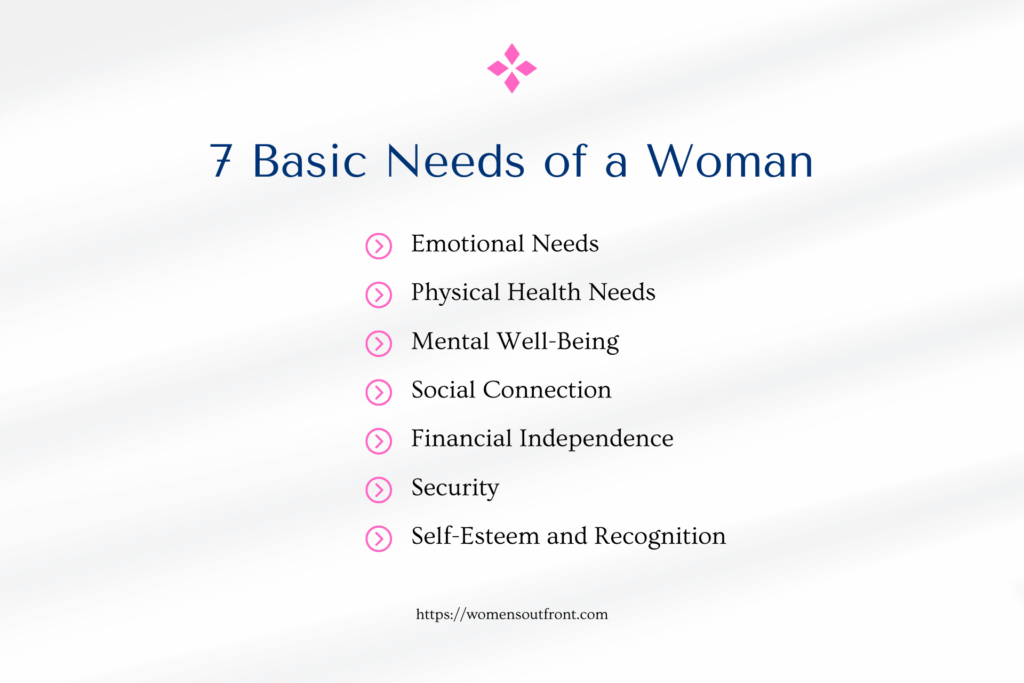
Let’s take a look at this key list:
- Emotional Needs: Understanding, compassion, and empathy are vital for emotional well-being. Women need to be heard, validated, and emotionally supported.
- Physical Health Needs: Women have unique physical health needs, including reproductive health care, regular check-ups, and healthy nutrition.
- Mental Well-being: Women need space, time, and resources to manage their mental health, including stress and emotional balance.
- Social Connection: Building meaningful relationships and feeling a sense of belonging within a community is a key need for women.
- Financial Independence: Economic autonomy, which includes earning and managing money, is crucial for women to live fulfilling and secure lives.
- Security: Feeling safe in various aspects of life, from physical and emotional to financial and social, is a fundamental need for every woman.
- Self-Esteem and Recognition: A sense of self-worth, feeling valued, and gaining recognition for one’s efforts and contributions are essential to a woman’s well-being.
Understanding these basic needs is the first step toward creating an environment where every woman can thrive.
Now that we’ve introduced a woman’s basic needs, we will explore each of these in depth. Understanding these aspects helps us appreciate the complexity and uniqueness of each woman’s experience and guides us on how to support them better.
So, without further ado, let’s jump into the specifics of each need.
Emotional Needs
How Does Empathy Play a Role in Women’s Lives?
Ah, the world of emotions! It’s a realm that’s as fascinating as it is complex, just like a thrilling roller coaster ride filled with twists and turns, ups and downs. It’s especially crucial when we’re talking about women’s basic needs, for at the heart of these lies a universal requirement: empathy.
Empathy isn’t just about understanding what another person is going through; it’s about feeling it with them. In a world that’s often quick to judge, a little empathy can go a long way, particularly in meeting women’s emotional needs.
What are the Emotional Needs Specific to Women?
Emotional needs, though intangible, play a massive role in shaping our experiences and overall well-being. For women, these needs often take on specific nuances, colored by both personal and societal contexts. In this section, we will cast the spotlight on women’s emotional needs.
We will understand how these needs deeply influence a woman’s life and how addressing these needs can create a foundation for emotional well-being.
So, let’s take the first step on this enlightening path.
Need for Understanding:
Women need to feel understood and to have their feelings recognized and validated. Whether it’s juggling multiple roles at home and work or dealing with societal pressures, every woman has her unique set of challenges. To understand her is to validate her experiences.
Need for Connection:
Women thrive on social connections and relationships. It’s essential to have meaningful interactions and emotional support from family, friends, or significant others. This connection creates a sense of belonging and love that’s integral to a woman’s emotional health.
Need for Expressiveness:
Women need space to express their feelings without fear of judgment or rejection. This freedom to express emotions fosters emotional resilience and helps navigate the highs and lows of life.
Need for Reassurance:
Women need reassurance and affirmation about their worth, abilities, or how they handle their roles and responsibilities. This reassurance builds confidence and fosters self-esteem.
Need for Empathy:
Women need empathy from those around them. Being empathetic involves acknowledging a woman’s feelings and experiences and offering emotional support, which is crucial for her psychological well-being.
So, as we meander through this emotional landscape, let’s remember that empathy is like the trusty compass guiding us. It’s the magic ingredient that can make a world of difference in fulfilling a woman’s emotional needs.
Physical Health
Are Women’s Needs Different?
Imagine a medical textbook where everyone, regardless of gender, is treated as one generic being. It would be a bit like trying to fit everyone into the same pair of shoes, wouldn’t it? Now, that’s not a comfortable thought.
Similarly, regarding physical health, women’s needs are indeed different and unique.
From reproductive health to hormonal changes, bone density to body fat distribution, there’s much more to a woman’s physical health than meets the eye.
What are the Unique Physical Health Needs of Women?
Regarding physical health, women have unique needs and considerations that stand apart from their male counterparts. These unique health needs are often tied to women’s biological makeup and lifecycle changes.
We aim to bring clarity and awareness to these distinct needs, equipping us with the understanding needed to promote and ensure the physical well-being of women.
Reproductive Health:
From menstrual health to pregnancy and menopause, a woman’s body experiences several unique physiological changes. Therefore, access to quality reproductive healthcare and understanding these changes are vital to women’s health.
Nutritional Needs:
Due to biological differences, women have specific nutritional needs. For instance, women require more iron to compensate for menstrual blood loss. They also need adequate calcium and vitamin D, especially after menopause, to maintain bone health.
Fitness and Exercise:
Exercise is essential for everyone, but women, in particular, can benefit from certain types of physical activity. Weight-bearing exercises, for example, can help prevent osteoporosis, a condition women are more prone to.
Preventive Care and Regular Check-ups:
Women should have regular health screenings, including mammograms and Pap tests, as they are at higher risk for certain health issues like breast and cervical cancer.
Mental Health:
Though not exclusively a physical need, mental health deeply impacts a woman’s physical well-being. Factors like hormonal changes can make women more susceptible to mood disorders. Therefore, an integrated approach that addresses both physical and mental health is essential.
Understanding these unique needs is the first step toward ensuring optimal health for women. It’s like having the right key for a lock; once you have it, everything falls into place.
So, let’s keep exploring and understanding these needs, one step at a time.
After all, a journey of a thousand miles begins with a single step. And oh, what an adventure it is turning out to be!
Mental Well-being
Why is It a Crucial Need for Women?
If we liken the human experience to a computer, mental well-being is the software that keeps everything running smoothly. The unseen yet powerful force shapes our thoughts, feelings, and overall quality of life.
For women, mental well-being isn’t just a basic need; it’s a crucial one.
Why? Because women, with their multiple roles and responsibilities, often juggle more than one can see.
Whether it’s managing a career while raising children, caring for aging parents, or battling societal expectations, women can experience various stressors. And just like a computer, when the software is under too much pressure, it can start to malfunction.
How Can Women Maintain and Improve Their Mental Health?
Mental health, an invaluable facet of our overall well-being, often takes the backseat in our fast-paced, bustling lives. When it comes to women, maintaining and improving mental health becomes even more crucial, considering the unique challenges they often encounter.
In this section, we’ll shed light on effective strategies and practices that can serve as the backbone for women to maintain and enhance their mental health.
Self-Care:
The adage “You can’t pour from an empty cup” holds true here. Self-care is not selfish; it’s essential. From taking a quiet walk and indulging in a favorite hobby to getting enough sleep – these activities rejuvenate the mind and can significantly improve mental well-being.
Support Systems:
Having a robust network of friends and family to rely on is like having a safety net during a tightrope walk. It’s comforting to know that there are people to turn to during tough times.
Therapy and Counseling:
Speaking to a professional can provide valuable insights and coping strategies. It’s like having a personal guide to navigate through the maze of the mind.
Mindfulness and Meditation:
Practicing mindfulness and meditation can help create a mental buffer against stress. It’s like a soothing balm for the turbulent mind.
Healthy Lifestyle Choices:
Regular exercise, a balanced diet, and avoiding harmful substances can significantly improve mental well-being. It’s about maintaining the machine so the software can run smoothly.
Remember, mental well-being is not a destination; it’s an ongoing journey. It’s about tending to the garden of the mind, nurturing it with the right care, and watching it bloom.
So, as we continue this wonderful journey of understanding women’s basic needs, let’s remember to pack some compassion, empathy, and, above all, a whole lot of understanding.
Social Connection
How Important Is it in a Woman’s Life?
Take a moment and picture a dance floor. Some folks are dancing solo; others are paired up, while some groups move in sync with the beat. Each person’s dance is unique, but they’re all connected by the rhythm of the music. This vibrant image is much like the importance of social connections in a woman’s life.
Each woman might dance to her beat, but the shared rhythm of human connection makes the dance of life meaningful.
What Role Does Social Interaction Play in Fulfilling Women’s Basic Needs?
My apologies for the oversight. Here’s a revised version of the introduction.
The power of social interaction in shaping our lives is often understated. These social connections can provide women joy, support, and personal growth. This section will explore how social interactions significantly fulfill women’s basic needs.
We’ll see how meaningful relationships can provide a strong foundation for women to construct a satisfying and well-rounded life. So, let’s embark on this journey of understanding the critical role of social bonds.
Sense of Belonging:
Engaging in social interactions can create a feeling of belonging, which is a core human need. Women thrive on relationships and communities – it’s like a chorus in a song; it brings harmony and connection.
Support System:
Social connections serve as a crucial support system, providing women with emotional assistance, advice, and a sense of security during challenging times. It’s the steady hand that steadies the ship during a storm.
Shared Experiences:
Sharing experiences, joy, and even sorrow with others enhances emotional well-being. It’s like seeing your reflection in a mirror – you feel seen, understood, and less alone.
Mental Health:
Regular social interaction can boost mood and act as a buffer against mental health issues. Remember, a problem shared is a problem halved!
Personal Growth:
Engaging with diverse people can provide new perspectives and stimulate personal growth. It’s like adding different spices to a dish, creating a unique and flavorful experience.
So, as we swirl and twirl on this dance floor of life, let’s remember that our steps are our own, but the connection with others gives our dance meaning.
Let’s keep dancing, connecting, and, most importantly, understanding the wonderful tapestry of women’s basic needs. After all, the dance of understanding has just begun!
Financial Independence:
Is it a Basic Need for Women?
What’s that saying about money making the world go-’round?
Well, it’s not far from the truth. Money may not buy happiness, but it sure can provide stability, security, and a degree of happiness. When it comes to women, financial independence isn’t just a nice-to-have; it’s a must-have. It’s a basic need that plays a starring role in the grand theatre of a woman’s life.
Why is Financial Independence Important for Women?
Empowerment:
Having control over one’s finances is empowering. It’s like having the reins to your own horse; you decide the pace, the path, and the destination.
Security:
Financial independence provides a safety net for unforeseen circumstances. Think of it as an umbrella on a rainy day, keeping you dry when life decides to pour.
Freedom of Choice:
Economic autonomy enables women to make independent life decisions. It’s like being the chef of your own life; you get to decide what goes into the recipe.
Confidence:
Managing finances and having economic autonomy can boost a woman’s confidence. It’s like a mirror that reflects her capabilities, reinforcing her belief in herself.
Improving Quality of Life:
Financial independence can improve living conditions access to healthcare, education, and leisure activities. It’s the key that opens the door to a multitude of possibilities.
Economic autonomy is more than just dollars and cents; it’s a means for women to shape their destinies, contribute, and thrive. As we venture further into this exploration of the basic needs of a woman, let’s remember that every penny counts.
So, keep those coins jingling, and let’s continue on this exciting journey of discovery. The expedition of understanding has just hit a gold mine! Are you ready for the treasures that lie ahead?
Security
How Does it Impact a Woman’s Life?
Security, in many ways, is like a warm, cozy blanket on a chilly winter’s night. It’s comforting, reassuring, and brings a sense of peace. For women, this blanket of security extends beyond the physical realm to include emotional, financial, and social aspects of life as well.
The question is, how does this security blanket impact a woman’s life?
What Does Security Mean for Women in Different Aspects of Life?
Physical Security:
This involves the basic need to feel safe from harm or danger. Imagine it as the sturdy walls of a house, protecting those inside from the elements.
Emotional Security:
Emotional security is about feeling confident in expressing emotions without fear of judgment or repercussions. Think of it as a warm fireplace, providing a safe space to express and be yourself.
Financial Security:
This refers to having enough resources to meet basic needs and emergencies. It’s like a well-stocked pantry, ready to provide sustenance whenever needed.
Social Security:
This is about feeling secure in one’s social position and relationships. Picture it as a comfortable couch where you’re welcome, accepted, and can relax.
Health Security:
This involves having access to healthcare and being able to maintain good health. Consider it as a first-aid kit, always there to patch up and heal.
Each aspect forms a layer of the security blanket, providing women with a sense of safety, confidence, and well-being. And as we continue to unravel the threads of understanding that make up women’s basic needs, let’s remember that everyone deserves to feel secure, like snuggling under a cozy blanket on a cold night. The journey of understanding continues, and the road ahead is full of promise.
How Does Security Impact a Woman’s Life?
Consider, for a moment, the safety and peace of mind that comes from knowing you’re secure. It’s a bit like having a trusty umbrella on a rainy day. This feeling of security is critical to women’s well-being and fundamental needs. It’s a vital part of the jigsaw puzzle that makes up a woman’s life.
What Does Security Mean for Women in Different Aspects of Life?
Physical Security is about feeling safe in one’s own body and personal space. It’s akin to having a solid fortress that safeguards one’s physical well-being from any harm.
Emotional Security allows a woman to express her feelings without fear of criticism, rejection, or any form of emotional harm. It’s like having a soft cushion to land on, allowing the natural flow of emotions.
Financial Security means having sufficient financial resources to cater to life’s necessities and surprises. The sturdy lifeboat keeps you afloat in the sea of life’s uncertainties.
Social Security is the assurance of being valued and accepted in one’s social circles and communities. Consider it your favorite gathering spot where you are always welcome and appreciated.
Health Security encompasses the access to and availability of health services needed to live a healthy life. It’s like a reliable health guide ready to provide advice and care when required.
These dimensions of security work together, like the pieces of a puzzle, to create the broader picture of a woman’s basic needs. They form the foundation for a woman to build a fulfilling, comfortable, and self-directed life.
As we walk further on this road of understanding the basic needs of women, let’s not forget to spread the word and help others join this enlightening journey. After all, sharing is caring, right? So, ready to share and shine?
Onward we go!
Self-esteem and Recognition
Do Women Need It?
Imagine standing on a stage with a spotlight shining on you. You’ve just achieved something big, and the crowd is applauding. How does that feel? Pretty great, right?
That’s the power of recognition and self-esteem. For women, these aren’t just nice-to-haves; they’re basic needs that often play the lead role in the epic drama of life.
How Does Self-esteem and Recognition Fulfill Women’s Basic Needs?
Confidence Booster:
Recognition and self-esteem work like an adrenaline shot to confidence. They’re like a personal cheer squad, boosting morale and motivation.
Validation:
Recognition validates a woman’s contributions and achievements; it feels like getting a gold star for a well-done job.
Self-Worth:
Self-esteem is an essential ingredient in the recipe for self-worth. It’s like the mirror that reflects a woman’s value to her.
Motivation:
Recognition is powerful, encouraging women to strive for their goals. Think of it as the wind beneath your wings, pushing you to fly higher.
Mental Health:
Healthy self-esteem can positively impact mental health, acting as a protective shield against stress and anxiety. It’s the invincible superhero cape that deflects life’s blows.
So, as we roll out the red carpet on our journey of understanding the basic needs of a woman, let’s remember that everyone deserves their moment in the spotlight.
A standing ovation for all the women out there, for you are the stars of your show.
Sharing is Caring
How Can Spreading This Knowledge Help Other Women?
You know that warm, fuzzy feeling you get when you share a delicious piece of cake with a friend? That’s the same feeling you get when you share knowledge, especially knowledge as vital as understanding the basic needs of a woman. Spreading this knowledge is like sprinkling magic empowerment dust, creating ripples of change.
How Can You Empower Other Women with this Information?
- Inspire Conversation: Start conversations about women’s basic needs. It’s like sparking a bonfire that lights up the night sky with understanding and awareness.
- Educate and Inform: Share this information with the women in your life. It’s like giving them a roadmap to understanding their own needs.
- Support and Empower: Use this knowledge to support and empower women around you. It’s like a reassuring pat on the back that says, “You’re not alone, and you’ve got this!”
- Advocate: Advocate for fulfilling women’s basic needs in your community and workplace. It’s the megaphone that amplifies the voice of empowerment.
- Act: Use this knowledge to inspire action. It’s the first step on the journey toward fulfilling these basic needs.
Empowerment Starts with Understanding Basic Needs
As our exploration draws to a close, remember this: empowerment is not a destination but a journey. It starts with understanding the basic needs of a woman and continues with the constant endeavor to fulfill these needs. It’s like an endless book series – each chapter is crucial, and there’s always another one to look forward to.
Let’s keep this conversation going like a river that never stops flowing. Pass on the baton of knowledge because when we empower one woman, we empower all women. And as the great Maya Angelou once said, “Each time a woman stands up for herself, she stands up for all women.”
In this beautiful relay race of understanding and empowerment, it’s now your turn to run. Ready to lace up those shoes and sprint towards spreading understanding?
We believe in you!
Let’s make every day an empowerment day!
After all, when women thrive, humanity thrives. Remember to share, care, and, most importantly, proudly wear your crown of empowerment!
Related Articles
Discover How to Change Your Mindset in Just 7 Easy Steps! Find How Step 3 is the Best!
Mindset Makeover: Transform Your Life with These 8 Game-Changing Attitudes!
5 Powerful Manifestation Techniques So Effective, You’ll Wish You Tried Them Sooner!
Manifestation Power: Unlock the Secret to Transforming Your Dreams into Reality!
How to Focus Your Attention Like a Pro: 7 Game-Changing Strategies You Can’t Miss!