

What Manifestation Techniques Actually Do
The research here is clearer than the internet suggests, and it does not say what most manifestation content says it does.
Manifestation techniques work on you, not on the world. They change what you notice, what you plan for, and whether you actually start.
The best-evidenced finding in this whole area is that vividly picturing the outcome you want, on its own, tends to make you less likely to get it. So we will not tell you the universe is listening.
We will show you what visualization, affirmations, journaling, meditation, and goal setting each do to a human being, which parts hold up, and how to rebuild the ones that don’t.
What none of this will move
And we will say plainly that nothing here moves a situation that money, health, immigration status, or somebody else’s decision is holding shut.

Key Takeaways
What the evidence supports, and what it does not
- Visualizing the outcome is the part that backfires. Across four experiments, people nudged into positive fantasies about a future they wanted came out with measurably less energy to chase it than people who questioned that future or imagined it going badly.
- Plan the trigger instead of picturing the prize. Spelling out when, where, and how you will act raised goal attainment by a medium to large margin across 94 separate tests, d = 0.65.
- Grand affirmations hurt the women most likely to reach for them. Repeating “I’m a lovable person” left participants with low self-esteem in a worse mood than saying nothing at all, while the boost to everyone else was small.
- Belief is not a lever on your circumstances. Where the block is money, caregiving, health, or a decision that belongs to somebody else, these manifestation techniques change how you approach it and nothing more, and that is worth knowing before you start.
Understanding manifestation
Manifestation is the practice of naming what you want, holding on to the belief that it’s reachable, and behaving as though it is. That’s the working definition, and it’s worth keeping separate from the claim usually bolted onto it.
The claim is that thought attracts outcome. Manifestation techniques are a set of attention and planning habits, and only one of those two things has evidence behind it.
The idea comes down to us from the Law of Attraction, a New Thought philosophy holding that positive or negative thoughts pull matching experiences toward a person. We will treat that as the history of the idea rather than as a mechanism.

The three parts, and the one that gets dropped
- Intention is where you name what you want, precisely enough that you’d know if you had it.
- Belief is the expectation that it’s reachable, which turns out to be a different thing from picturing yourself already there.
- Action is what closes the gap, and it’s the part the popular version quietly drops.
Hold on to that second one. The gap between expecting something and savoring it in advance is the hinge this entire subject turns on.
Why this lands differently for women
Manifestation techniques are marketed mainly to women, and they tend to arrive at the moments when a woman has the least room to move. After a layoff, during a divorce, in the middle of caregiving that has already eaten the calendar.
That timing isn’t an accident, and it’s why the honest version matters. A practice that tells you the block is your attitude, at the exact point your week is genuinely full, costs you the little time you had left and hands you a reason to blame yourself for the result.
Why picturing the outcome usually backfires
Here’s the finding almost no manifestation article mentions, because it points the wrong way. Gabriele Oettingen has spent three decades testing what fantasizing about a wanted future actually does, and the answer is consistent.
The study that started it
In a 1991 study with Thomas Wadden, 25 women entering a year-long behavioral weight program had both their expectations and their spontaneous fantasies measured before they began. The two predicted the outcome in opposite directions.
Optimistic expectations went with losing more. Positive fantasies went with losing less, and the women who combined pessimistic expectations with positive fantasies did worst of all.
That’s 25 women in one program, so hold it loosely on its own. What makes it worth your attention is that the effect kept turning up as the work got bigger.
What happened when they tested why
Twenty years later, in 2011, Heather Kappes and Oettingen ran four experiments to find out why. People prompted into positive fantasies showed lower energy, on both physiological and behavioral measures, than people prompted to question the future or to imagine it going badly.
Their reading is that a vivid enough fantasy lets you experience the reward now, which conceals the need to go and earn it. Your body settles, because as far as it can tell you’ve already arrived.
So the vision board isn’t neutral. It’s doing something, and what it’s doing is spending the motivation you were trying to build.
What this does not say
Worth being precise about the limits. This research is about fantasizing over an outcome, not about hope, and not about whether you’re allowed to want things.
Rewrite one wish as a plan you can run this week
This is the rebuild, and it’s the part worth keeping. Pick one thing you actually want and put it through these four boxes instead of onto a board.
Copy the table out and fill the third column in. It should take about ten minutes, and the fourth row is the one most people skip.
| Box | What goes in it | Yours |
|---|---|---|
| The wish, in one line | What you want, specific enough that you would know if you had it | |
| The obstacle inside you | The thing about your own behavior that stops it, not the economy | |
| The if-then | If (that obstacle, or a moment that already exists), then I will (one small action) | |
| The obstacle outside you | What no amount of planning moves, and who you would actually need for it |
The third row is the one carrying the evidence. In 2006, Gollwitzer and Sheeran pooled 94 independent tests of if-then plans and found a medium to large effect on whether people reached their goals, d = 0.65.
The format is doing the work. “I will exercise more” is a goal, while “if it is Tuesday at seven and the kids are at practice, then I walk the loop by the school” is an implementation intention, and it’s the second kind that shows up in the results.
Notice that the fourth row has no action attached to it on purpose. Some obstacles aren’t yours to plan around, and writing them in the right column is how you stop treating them as personal failings.
Rewriting an affirmation so it does not backfire
In 2009, Wood, Perunovic and Lee gave 68 students a tone every 15 seconds for four minutes, and asked half of them to repeat “I’m a lovable person” each time it sounded. Participants with low self-esteem came out of it in a worse mood than the ones who had said nothing.
The researchers read this as a statement landing too far outside what you already believe, so you reject it, and the rejection reminds you of the gap. Their paper suggests, carefully, that moderate and specific self-statements are less likely to do this than global, extremely positive ones.
So shrink the claim until it’s one you can check. Three examples of the swap:
- Instead of “I am successful,” try “I sent three pitches this week.”
- Instead of “I am lovable,” try “I called my sister back when I said I would.”
- Instead of “Abundance flows to me,” try “I know what is in the account and what is due on the 30th.”
Every one of those is verifiable by Friday. That’s the difference, and it’s the opposite of what most affirmation lists tell you to do.
The five manifestation techniques
What each one really does
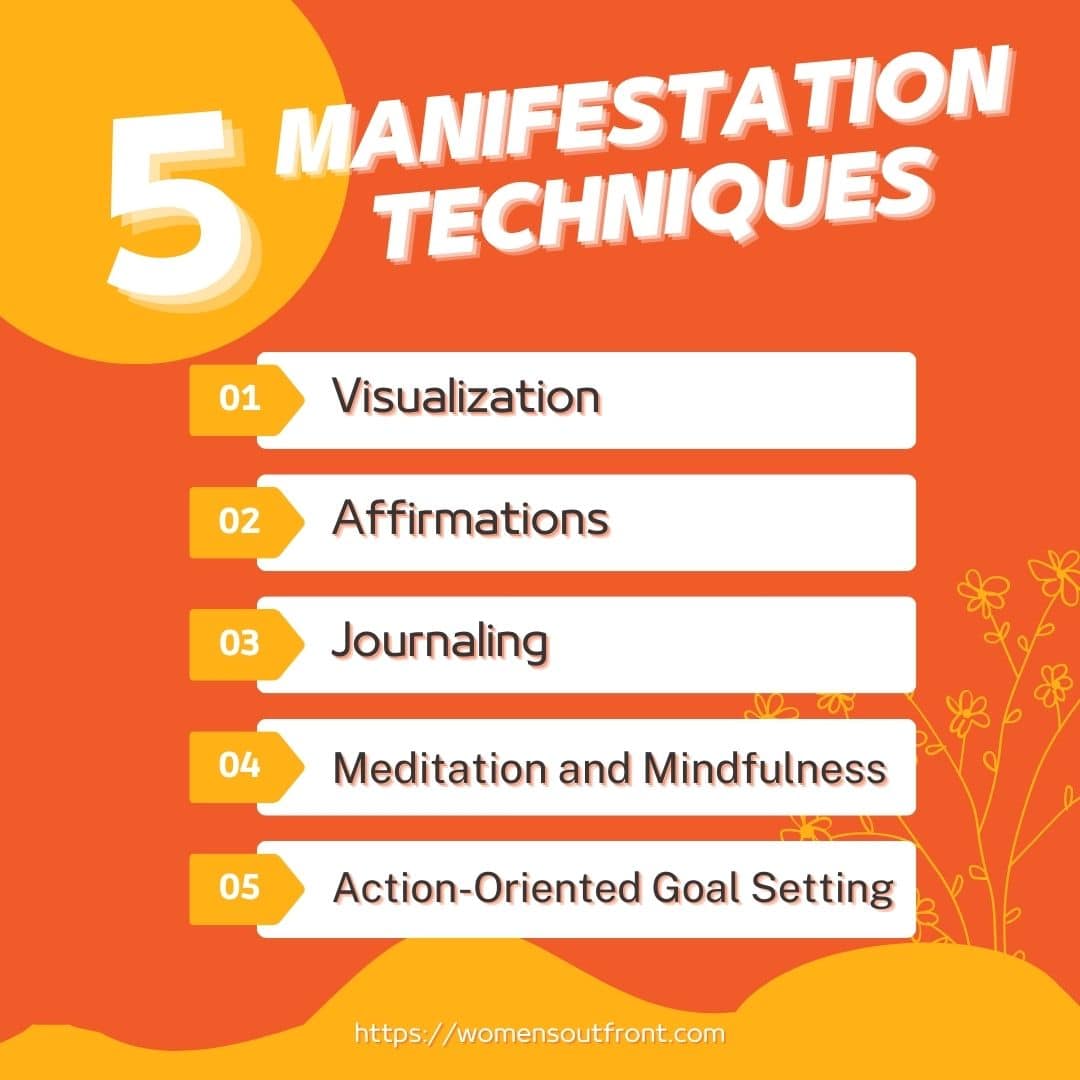
These are the five manifestation techniques that every list includes, which is why we have kept them. What follows is what each is actually good for, once you take the mechanism claim out.
1. Visualization
Picture the process, not the podium. Rehearse the awkward opening sentence of the conversation rather than the handshake at the end of it.
Better still, hold the outcome and the obstacle in mind together, which is what the fourth row of the table is for. Visualizing the finish on its own is the exact thing the research above found draining.
2. Affirmations
Scale is what breaks them, and we have covered the fix. Keep them small, specific, and checkable.
Treat any statement that makes you flinch as a sign it’s too big, not as a sign you need to say it harder. The flinch is information.
3. Journaling
This one attracts the least argument, mostly because it’s doing something quite ordinary. Writing a goal down forces the vagueness out of it.
Use it on the obstacle rows especially. A wish stays comfortable for as long as it stays unwritten.
4. Meditation and mindfulness
Meditation isn’t a manifestation technique and doesn’t need to be one. It’s a reasonable way to lower the noise, and five minutes is a real amount of it.
If sitting quietly isn’t available to you this month, it’s not a prerequisite for anything else here. Skip it without guilt and come back when there’s room.
5. Action-oriented goal setting
This is the if-then row wearing a longer name. Break the wish into pieces that fit inside a real week rather than an imaginary one.
Then attach each piece to a moment that already happens whether or not you’re organized. A plan with no trigger is a wish with extra steps.
Using this on your own situation
Here’s the table filled in. The woman in it is a composite we have assembled from the situation that turns up most often in this audience, not a real person and not a testimonial.
| Box | Filled in |
|---|---|
| The wish, in one line | Move from a 32-hour admin job to a full-time role paying at least 12,000 dollars more |
| The obstacle inside you | I open the job board, read six listings, decide I am underqualified, and close the tab |
| The if-then | If I have read a listing and started talking myself out of it, then I apply before I close the tab |
| The obstacle outside you | Childcare ends at 5:30 p.m., so anything with a hard 6 p.m. expectation is out until September. That is a scheduling fact, not a belief |
A projection is a model, not a forecast.
This calculation uses the assumptions listed beside it. Change an assumption and the answer changes, sometimes a great deal.
The arithmetic is shown so you can check it and substitute your own figures. Treat the output as one input into a decision, not the answer to it.
Run the number before you run the feelings
Twelve thousand dollars a year sounds decisive until you divide it. Across 26 paychecks that’s about 460 dollars each, before anything comes out.
Take off roughly a quarter for tax and withholding and it’s nearer 345 dollars. That fraction varies by your bracket and your state, so run it with your own figures rather than ours.
Then subtract what the change costs
Now add the childcare her new hours would need. At 200 dollars a month that’s 2,400 dollars a year, or about 92 dollars a paycheck, and 345 less 92 is about 253.
So 253 dollars a paycheck is the figure that has to beat the longer commute and the lost flexibility. Not 12,000, which is the number she would have put on a vision board.
If you have seven minutes rather than an evening
Do one row. Write the if-then for the single thing you keep not starting, and stop there.
One trigger attached to one action is the entire mechanism. Everything else on this page is detail you can add when there’s more room.
What to watch out for
Three ways manifestation techniques go wrong, and what to do about each.
Treating a structural block as a mindset block
If the obstacle is money, a health condition, immigration status, a custody order, or a manager who has already made up his mind, no amount of visualizing moves it. That’s not pessimism, it’s arithmetic.
Putting it in the outside column is what stops you spending six months auditing your beliefs about a problem that was never in your head. It also frees you to go after the part that is.
Using the practice to avoid the first hard step
The energy finding is the mechanism here. If a session leaves you calm and no closer, that’s the effect working exactly as it was described.
Set yourself a rule that every session ends with something written in the if-then row. A practice that never produces an action is a hobby, which is fine, as long as you know that’s what you have.
When it is not a motivation problem at all
Low mood that will not lift, losing interest in things you used to care about, sleep that has been wrong for weeks, or thoughts of harming yourself aren’t addressed by any of the manifestation techniques above.
That’s the point to see a licensed clinical psychologist or a psychiatrist, and to go before you spend another season trying to think your way out of it. If you’re in crisis in the United States, call or text 988 for the Suicide and Crisis Lifeline.
Frequently asked questions
How long does it take to see results from manifestation techniques?
There’s no honest answer to this, because the word “results” is doing all the work in the question. What does have a timeline is your own behavior.
Write one if-then this week and act on it twice, and inside two weeks you’ll know whether the trigger you picked was realistic. That’s the thing to measure, and it’s measurable.
What if I try this and nothing changes?
Look at which column the obstacle was in. If it was the outside one, nothing was going to change from your end and the manifestation techniques were never the problem.
If it was the inside one, the usual fault is a trigger that doesn’t actually occur. Pick a moment that happens whether or not you’re having a good week, like school drop-off or the end of a shift.
Is it wrong to want the version where the universe helps?
No, and we aren’t going to try to argue you out of it. Plenty of women find the ritual steadying, and a practice you’ll keep beats a better one you drop by the end of the month.
What we will not do is tell you it’s the reason things move, because we can’t show you that. You’d be right to ask, and we would rather you kept asking.
Can manifestation techniques help with relationship goals?
They can help you get specific about what you’re looking for and then act on it, which isn’t nothing. They can’t produce a person, and they can’t change one who has already told you where he stands.
The if-then works here too. “If I am about to cancel on the thing where I would meet people, then I go for forty minutes and leave.”
Do affirmations work if I do not believe them?
On the evidence above, that’s precisely the case where they backfire. Disbelief isn’t a failure of commitment, it’s the signal that the statement sits too far outside what you’d accept.
Shrink the claim until you can say it without wincing, then let it grow from there. A small true thing beats a large one you’re arguing with.
Where to go next
Pick one row of the table and do it this week. That’s the whole ask, and the fourth row counts.
- If the affirmation rewrite is the part you’ll actually use, we go into the wording in more detail in our piece on affirmations for women.
- The trigger problem in the second question above gets much easier once a morning already has a shape, which we work through in building a morning routine.
- For the outside-obstacle column, what helps is a plan for the setback rather than a better attitude toward it. We cover that in how to create a resilience plan.
- If the wish row keeps coming out blank, start further back, with what you actually need before what you want.
If you’d rather start by seeing where the time is going, our work life balance quiz takes a few minutes and gives you something to put in the obstacle rows.
Send this to the friend with the vision board
You already know which one. She has done everything the manifestation accounts told her to, her situation hasn’t moved, and she has started to suspect that’s a verdict on her.
It’s not, and the first takeaway is the piece to send her. Tell her the research says the picturing is the part that drains you, not that she wasn’t believing hard enough.
If she’s in the middle of something heavy right now, the table will keep. The one line about outside obstacles is enough on its own.